How to Improve Agency Team Productivity Without Burning Out Staff
Published 2026-05-09 · 10 min read · By Agencio Team
Improve consultancy team productivity with process clarity, role-based ownership, and operational automation that protects service quality.
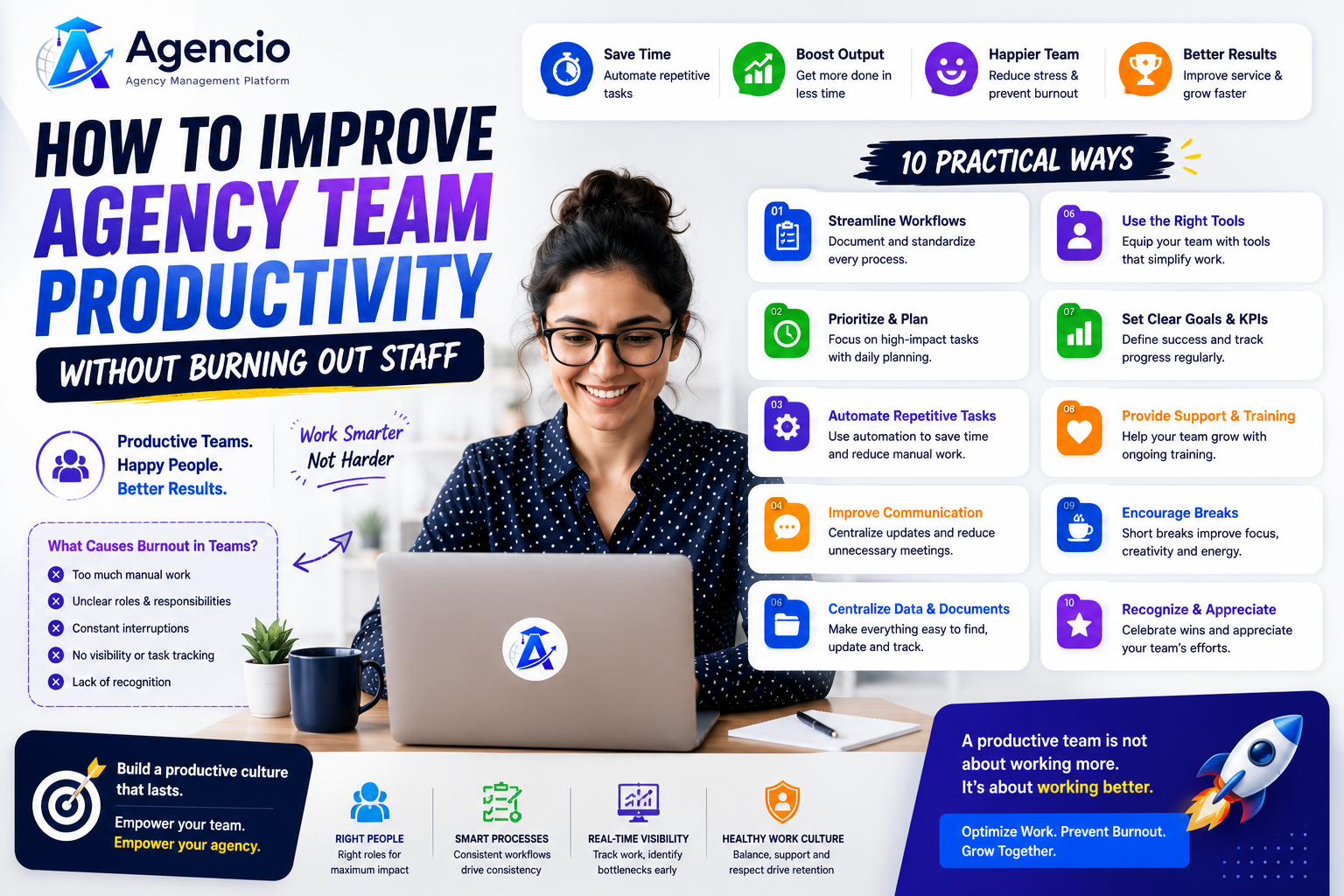
Eliminate context switching
Productivity drops when staff jump between spreadsheets, chat threads, and disconnected tools. A unified platform reduces cognitive load and keeps work focused.
When task context is centralized, response quality improves and delays become easier to prevent.
Design accountable ownership
Assign clear owners for each stage and each support function. Accountability is the foundation of predictable turnaround time.
Role-based permissions also reduce accidental changes and strengthen data discipline across the organization.
Measure outputs, not activity
Track resolved files, stage cycle time, and support resolution quality instead of raw activity volume. Output metrics reveal whether the process is truly improving.
High-performing teams combine measurable targets with periodic workflow reviews to sustain progress without overloading staff.
Create a continuous improvement loop
Use monthly retrospectives to review bottlenecks, repeated ticket categories, and stage delays. Convert findings into specific process changes.
Sustainable productivity comes from system improvements, not constant pressure on staff.
Key takeaways
- —Centralized context directly improves productivity and quality.
- —Clear ownership reduces delays and confusion.
- —Process improvement loops maintain performance without burnout.
How Agencio supports this workflow
Agencio brings student files, partner agencies, universities, documents, costs, invoices, support tickets, notifications, and role-based permissions into one agency management system. That gives consultancy teams a cleaner operating model for daily work, management review, and student-facing service.
Frequently asked questions
What causes the biggest productivity loss in agencies?
Context switching between multiple disconnected tools and unclear ownership across stages.
How often should process reviews happen?
A short weekly operational review plus a deeper monthly improvement review works well for most teams.