What Is an Agency Management System? A Practical Guide for Growing Teams
Published 2026-05-08 · 11 min read · By Agencio Team
Understand what an agency management system does, why operations teams adopt it, and how to choose one that scales with student consultancy workflows.
Why agencies move away from spreadsheets
Most agencies do not fail because of weak sales. They struggle because operations become fragmented across sheets, chat apps, and personal follow-up notes.
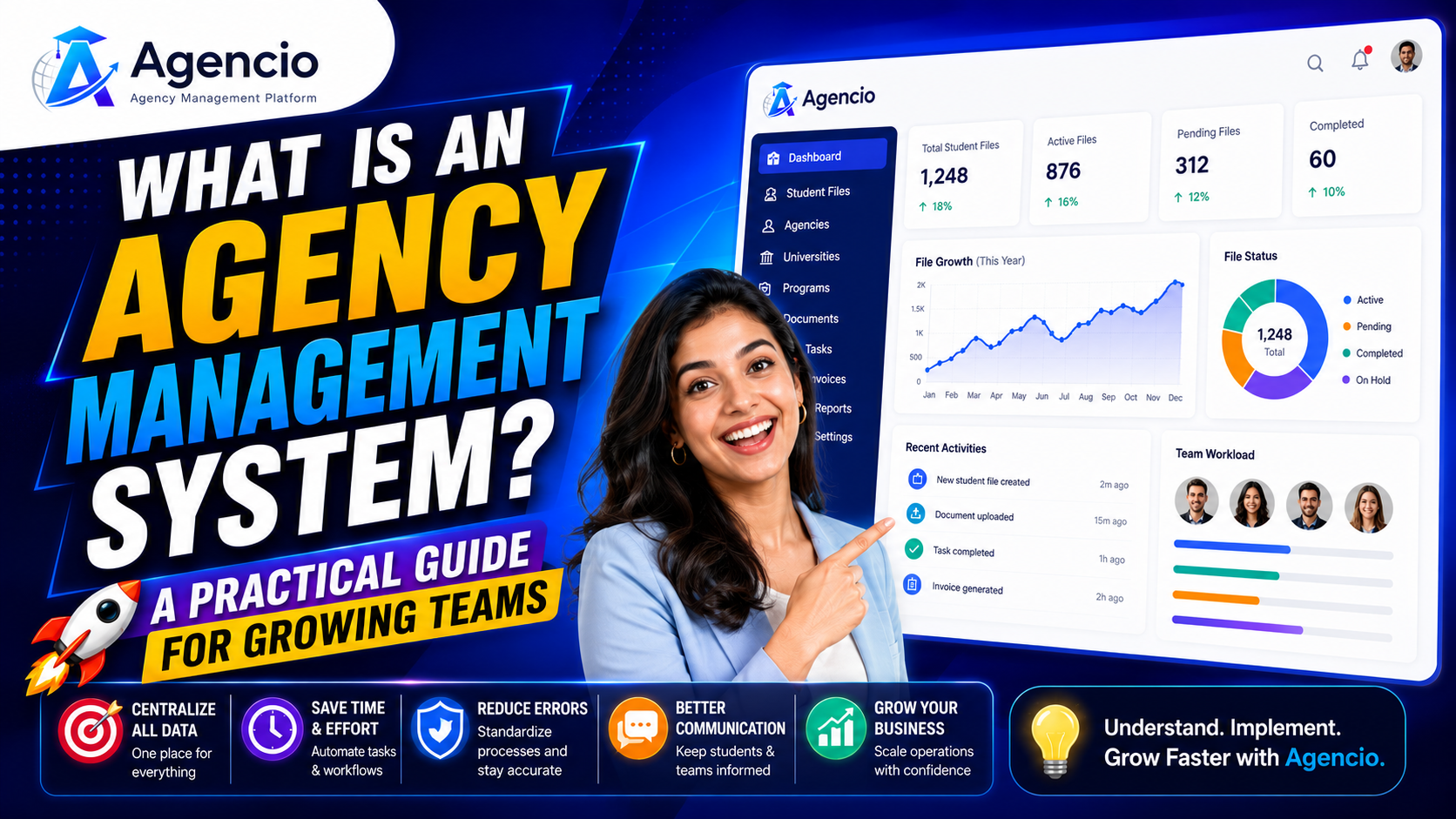
An agency management system creates one source of truth for student files, communication history, status updates, documents, and financial records. This removes guesswork and helps teams collaborate with confidence.
Core capabilities to expect
A dependable platform should include student file tracking, agency and university management, role-based access, document workflow, support ticketing, and reporting.
For education consultancies, it should also support stage-based progress updates, student portal access, and process visibility for managers who need quick decision-making data.
How to evaluate options realistically
Start with workflow fit, not feature count. Ask whether the system reflects your current process and can adapt to your future process.
Then validate access control, search quality, reporting depth, onboarding support, and total cost over one year. The right system is one your team can adopt quickly and use consistently.
Expected outcomes after implementation
Most agencies see immediate operational benefits: fewer missed follow-ups, faster handovers, and better visibility into stage-wise progress.
The long-term value comes from consistency. When every case moves through a shared system, leadership can optimize performance with data instead of assumptions.
Common implementation mistakes to avoid
A frequent mistake is trying to recreate every old spreadsheet behavior inside the new system. This slows adoption and keeps bad habits alive.
Another mistake is skipping ownership design. If roles and responsibilities are unclear, even strong software cannot create operational discipline.
What to track in the first 90 days
Use early metrics such as follow-up completion rate, stage aging, unresolved tickets, and document turnaround time to validate process health.
If these indicators improve while team effort remains stable, the system is delivering practical value beyond feature usage.
Key takeaways
- —Prioritize workflow fit over long feature lists.
- —Centralization improves speed, handover quality, and reporting confidence.
- —Measure 90-day operational outcomes, not only implementation completion.
How Agencio supports this workflow
Agencio brings student files, partner agencies, universities, documents, costs, invoices, support tickets, notifications, and role-based permissions into one agency management system. That gives consultancy teams a cleaner operating model for daily work, management review, and student-facing service.
Frequently asked questions
How long does adoption usually take?
Most consultancies can adopt core workflows in a few weeks if ownership, data structure, and training are defined clearly.
Can small teams benefit from an agency management system?
Yes. Smaller teams often gain faster because centralized context reduces manual follow-up pressure and context switching.